Showing posts with label paulo santos. Show all posts

11/03/2008

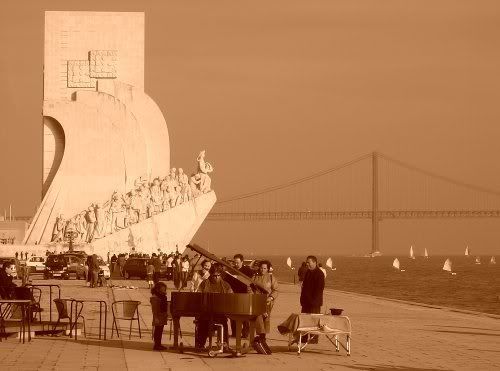
#71 - Please, play once more...

Photobucket - Video and Image Hosting

Photobucket - Video and Image Hosting
(all photos from Paulo Santos)

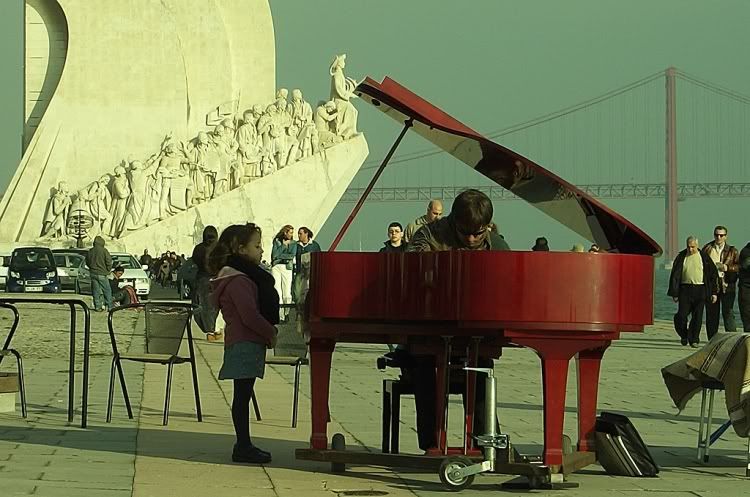
... asked Sailor Girl to a cute pianist named George Townboy. He hypnotized all with his music and charm at Padrão dos Descobrimentos.

(Yes, he's cute!)

The names have been adapted, they are not real :)

10/03/2008

#70 - Homeless

Photobucket - Video and Image Hosting

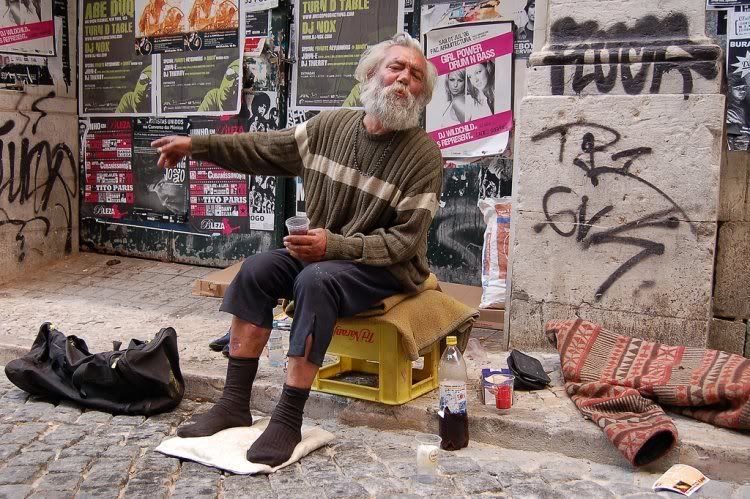
This picture was taken by Paulo Santos in the Bairro Alto.

Bairro Alto is an area of central Lisbon.
Nowadays, it functions as a residential, shopping and entertainment district. Bairro Alto is one of the oldest districts of Lisbon. Dozens of fado singing clubs animated the area. All the major Portuguese newspapers had their offices in there. Prostitution was visible and considerable.
Since the 1990s, Bairro Alto went through major changes. Lisbon's city council made extensive repairs, and dozens of new restaurants, clubs and trendy shops were opened. Many young people moved into the area. Cars were banned (except for residents and emergency vehicles). Today, Bairro Alto (or just Bairro) is the heart of Lisbon's youth culture and nightlife. Lisbon's punk, gay, heavy metal music, goth, hip hop and reggae scenes all have the Bairro as their home, due to the number of clubs and bars dedicated to each of them. During daytime, the Bairro is a traditional district where older people shop for groceries, and the younger generations visit art galleries like Zé dos Bois, bookshops like Ler Devagar or arty gift shops like Hold Me.
Despite the heavy police presence, illegal drugs are sold in the streets. In 1995, a group of far-right skinheads attacked and killed Alcino Monteiro, a Portuguese citizen of African origin. This zone struggles with a problem of vandalism, with graffiti destroying historical buildings, such as the birthplace of Fernando Pessoa.

22/02/2008

#53 - Colorful Lisbon

Photobucket - Video and Image Hosting
Paulo Santos's photo
The Madragoa is a popular neighborhood of Lisbon, near the Tagus river, whose name comes from the presence in times of the Convent of the Madres de Goa. The legend mind that the neighborhood was born of the thousands of grains of sand that the seagulls transported to there. The origin of the name is lost in time. Some people say that the word refers to the nickname of a fidalga from Madeira Island "Mandragam" or that comes from "Mother of Goa." Before the earthquake, in XVll century, the district had the name "Moçambo" and was not more than a small town inhabited mainly by people of African origin. In the past, part of Madragoa was a cluster of convents and palaces, where they lived the Trinas, Bernardas or Inglezinhas. But were the workers who gave life to the neighborhood. Among the XVlll and XlX centuries, the population significantly changed. At that time, many people came to Lisbon from the region of the Ria de Aveiro, in particular from Ovar, hence the name ovarinas. Subsequently, most of these people have chosen to stay in Madragoa. Most were married, fishermen and varinas. Among many of the architectural works of Madragoa was the Palace of the Dukes of Aveiro, the House of the Marquis de Abrantes and older and modest chapels of Lisbon, the Mártires. Also there is the Embassy of France, where Gil Vicente (after St. George's Castle), initiated the Portuguese theater.

21/02/2008

#52 - Ponte Vasco da Gama

Photobucket - Video and Image Hosting
Paulo Santos 's photo
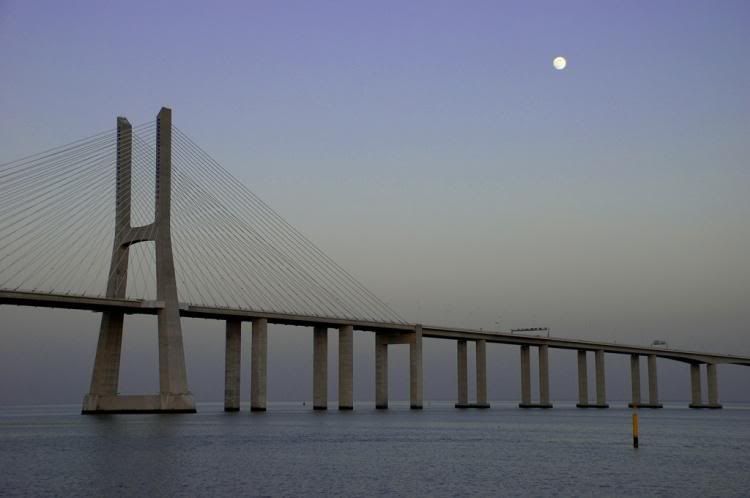
"The Vasco da Gama Bridge is a cable-stayed bridge flanked by viaducts and roads that spans the Tagus River near Lisbon, capital of Portugal. It is the longest bridge in Europe (including viaducts), with a total length of 17.2 km (10.7 mi), including 0.829 km (0.5 mi) for the main bridge, 11.5 km (7.1 mi) in viaducts, and 4.8 km (3.0 mi) in dedicated access roads. Its purpose is to alleviate the congestion on Lisbon's other bridge (25 de Abril Bridge), and to join previously unconnected motorways radiating from Lisbon.
The bridge was opened to traffic on March 29, 1998, 18 months after construction first began, just in time for Expo 98, the World's Fair that celebrated the 500th anniversary of the discovery by Vasco da Gama of the sea route from Europe to India."

16/02/2008

#47 - "Yeah, it's been a hard day's night"

Photobucket - Video and Image Hosting
Paulo Santos 's photo

It was taken in December in a garden of Parque das Nações