18/05/08

#139 - The place where I was born

Photobucket - Video and Image Hosting

Maternidade Alfredo da Costa

The Parenting Alfredo da Costa is located in the parish of São Sebastião da Pedreira. It was built on the foundations of a temple, with the project architect Miguel Ventura Terra.

The first maternity in Lisbon to be designed and built from scratch was inaugurated on December 5, 1932. He was its founder and first director Professor Augusto de Almeida Monjardino. It appears that the work of special protection and defence of pregnant women have taken beginning in 1755, after the earthquake that destroyed more than half of the city of Lisbon. One of the buildings destroyed, not only by the earthquake but also by the subsequent fire, was the All Saints Hospital, whose patients had to be transferred to the College of St. Anthony. This building was once outside the main house of Jesuits and was seized with all other property.

17/05/08

#138 - The return of lunch

Photobucket - Video and Image Hosting

Rua Actor Tasso

15/05/08

#137 - Ponte Vasco da Gama


Photobucket - Video and Image Hosting

Photobucket - Video and Image Hosting


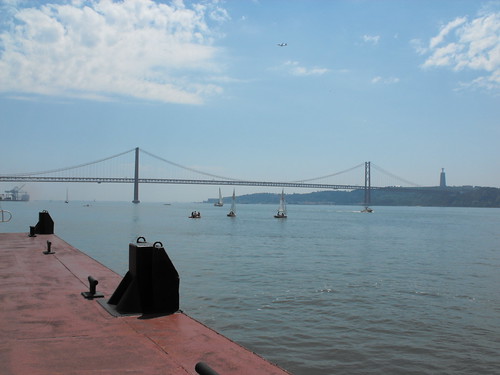
This newest bridge in Lisbon, Ponte Vasco da Gama, enables north-south traffic to bypass the Portuguese capital and was built as an alternative route to the 25 de Abril Bridge, frequently congested with traffic jams especially during the rush-hour periods.

This seemingly never-ending bridge is a Cable-stayed bridge. The builders took special steps to protect a local bird sanctuary and rehoused 300 families, who were living in slums, to much better accommodation

Vasco da Gama is the largest bridge in Europe with a length of 17.2 km (10 miles), 10 km of which are over the Tagus river. It was inaugurated on the 4th of April 1998. Located right next to the Nations Park (former site of the Expo 98) it got its name on the same year of the 5th centenary of the arrival of Vasco da Gama to India.

The bridge was designed to withstand an earthquake four times greater than the 1755 earthquake that devastated Lisbon. [*]

#136 - Drought fountain

Photobucket - Video and Image Hosting

In Público (22/4/2008)

«O que faz uma sereia quando lhe cortam a água? Vai nadar para outras paragens? Definha até por fim a bela cauda se lhe transformar em duas pernas? Aluga um jacuzzi? Vai para dois anos que a fonte do Rossio virada ao Teatro Nacional D. Maria II está sem pinga de água, para desespero das belas figuras que a ornamentam. Nos primeiros tempos de seca, a Câmara de Lisboa optou por esconder as ousadas raparigas atrás de um tapume que não as deixava sequer ver uma das praças mais bonitas e mais fotografadas da cidade. Depois seguiu-se uma segunda fase de encarceramento, um regime de liberdade provisória em que já só havia uma rede a separar as sereias do resto do mundo. Convencido de que não havia, afinal, a esperar delas nenhuma espantosa fuga cidade fora, quem sabe se até ao mar, o actual executivo municipal retirou dali a vergonhosa vedação que as rodeava e voltou a mostrá-las ao mundo como elas nunca deviam ter estado: despidas de água, ao contrário das suas irmãs da fonte do lado oposto da praça, que continuam a fazer as delícias de quem gosta de chapinhar nos dias quentes. Razões para tamanha maldade, a câmara não apresenta nenhumas. Resta às sereias rezar - rezarão as sereias? - ou ensaiar uma dança da chuva de cada vez que sentirem a pele encarquilhar-se ao sol.»

"What does a mermaid when it cut the water? Swim to other lands? Decline until finally the beautiful tail turn on two legs? Rented a Jacuzzi? Its been two years since the Rossio fountain facing the National Theatre D. Mary II is without water, to despair of the beautiful pictures that adorn. In the early days of drought, the Board of Lisbon opted to hide the beautiful girls behind a tapume so they can not even see the one of the most beautiful and photographed squares of the city. Then followed by a second phase of imprisonment, a system of provisional freedom in which we only had one network to separate the mermaids from the rest of the world. Convinced that there was, after all, none of them expect the astonishing escape outside town, who knows if to the sea, the current executive municipal withdrew away the shameful that the fence around again and show them the world as they never should have been : stripped of water, unlike their sisters fountain of the side of the square, which continue to be the delight of those who likes splashing in the hot summer days. Reasons for such evil, the camera does not present any. It remains to pray mermaids Or tested a dance of rain each time you feel the skin shrink in the sun. "

In Público (22/4/2008)

14/05/08

#135 - Rossio Station III

Photobucket - Video and Image Hosting

Photobucket - Video and Image Hosting

13/05/08

#134 - Rossio Station II

Photobucket - Video and Image Hosting

Photobucket - Video and Image Hosting


The clock tower :)

12/05/08

#133 - Rossio Station

Photobucket - Video and Image Hosting

Photobucket - Video and Image Hosting


"In neo-manueline style, the Rossio railway station is an outstanding building set between Rossio Square and Restauradores Square and was designed by the architect José Luís Monteiro.
The eight doors match the nine palatial windows and the incredibly decorated clock tower located on the top of the facade.Rossio station is a curiosity in that the platforms are some 30 metres above the main entrance. Services from here are all suburban trains to the tourist sights of Sintra via Queluz.
Built in 1886/87, this station has been recently renovated. The boarding platform is now connected to the Metro Station, though this is with the nearest Metro station at Restauradores, (not with Rossio Metro) and the work done on the ceiling is simply breathtaking.
Make sure you pay a visit to the Rossio Station, I'm sure you'll find it worth it." [*]

11/05/08

#132 - Gulbenkian Series X


Photobucket - Video and Image Hosting


10/05/08

#131 - Gulbenkian Series IX

Photobucket - Video and Image Hosting

Photobucket - Video and Image Hosting

09/05/08

#130 - Gulbenkian Series VIII

Photobucket - Video and Image Hosting

08/05/08

#129 - Gulbenkian Series VII


Photobucket - Video and Image Hosting

Photobucket - Video and Image Hosting

Photobucket - Video and Image Hosting

07/05/08

#128 - Gulbenkian Series VI

Photobucket - Video and Image Hosting

Photobucket - Video and Image Hosting


Museum
The Building
"The project for the Calouste Gulbenkian Foundation and Museum, inaugurated in 1969, was the result of a limited competition that took place from, 1959 to 1960 between three teams of architects. The ambitious and detailed specifications being based on the presupposition that the new building was to serve as “a perpetual homage to the memory of Calouste Gulbenkian, and its lines were to reflect the essential features of his character – concentrated spirituality, creative force and simplicity of life”. The project had to take into consideration various types of installations to house the museum, auditoriums and library and also the administrative and technical services of the foundation. The site chosen was the Parque de Santa Gertrudes in Palhavã, Lisbon (the present site).
From the three solutions jointly presented that of the team made up of the architects Ruy Jervis d’Athouguia, Pedro Cid and Alberto Pessoa was selected as fulfilling the requirements of the commission to produce a sober, dignified building in a unified architectural setting. A large number of specialists in various areas worked on the project co-ordinated by the winning team. The remaining two projects were by an architectural team made up of Arnaldo Araújo, Frederico George and Manuel Laginha, and the other by Formosinho Sanches, Arménio Losa and Pádua Ramos.
The existing architectural ensemble, simple in line with different areas ably linked together, is surrounded by a green area designed by the landscape architects Gonçalo Ribeiro Telles and António Viana Barreto, with lawns, trees, pools and even an open-air amphitheatre. The exterior or the museum is like a massive rectangular parallelepiped set on one of its longer sides where the use of concrete and granite creates a mellow chromatic equilibrium. Planned in relation to each object collected by Calouste Gulbenkian, on the lower floor it has a Temporary Exhibition Gallery, a small auditorium, a museum shop and cafeteria as well as the Art Library. A defining mark in Portuguese museum architecture, the edifice of the Museum is organised round two gardens with numerous tall picture windows that enable the visitor to enjoy Nature and Art. A noteworthy example of the latest trends in modern Portuguese architecture of the 1960s, the Calouste Gulbenkian Foundation was awarded the Valmor Prize for Architecture, in 1975. " [*]

06/05/08

#127 - Gulbenkian Series V

Photobucket - Video and Image Hosting


One of the many things I learned in blogs is that there is always a different duckling.
Different doesn't mean ugly, as ever learned by the stories.
Indeed in my point of view, is the difference that makes everything more interesting.

05/05/08

#126 - Gulbenkian Series IV


Photobucket - Video and Image Hosting

Photobucket - Video and Image Hosting


04/05/08

#125 - Gulbenkian Series III


Photobucket - Video and Image Hosting

Photobucket - Video and Image Hosting
"A comprehensive collection of contemporary art and sculpture has also been acquired over the years, mainly Portuguese but with some works by British artists. This is housed in the José de Azeredo Perdigão Modern Art Centre.Modern Art Centre was opened in 1983 in southern part of the Gulbenkian Park. Ten years later, as a tribute to the Chairman of the Foundation's first Board, it was renamed the José de Azeredo Perdigão Modern Art Centre (CAMJAP).
The CAMJAP building consists of two separate sections: the Modern Art Museum, which comprises three interconnected galleries, and a space for cultural events, including a multi-purpose room for events and meetings. A reception hall with a cafeteria and bookshop links these premises." [*]

03/05/08

#124 - Gulbenkian Series II


Photobucket - Video and Image Hosting


번역 Переводчик 译者 翻訳者 المترجم